Porto Katsiki, Egremni or Kathisma: which one is worth it today
Three big beaches on one coast, three completely different days. One is officially closed, one you reach without climbing a single step, and the afternoon wind, which is not called meltemi, decides your day more than any morning plan.
Everyone arrives in Lefkada with the same three names in mind. These are the cover beaches, and the west coast really does look like that: white walls cut straight down, pines running all the way to the pebbles, a blue no photograph gets right.
What the cover leaves out is how different they are from one another, that one of them is officially closed, and that the afternoon wind changes your day more than anything you planned over breakfast.
I have done all three dozens of times, in June and in August, at dawn and at sunset. Here is the comparison I give my guests when they ring me from the road asking where to go today.
This coast moves, quite literally
The west coast of Lefkada sits on an active fault. That is not guidebook language, it is the reason the beaches look the way they do and the reason access to them changes from one year to the next.
On the seventeenth of November 2015, around eleven in the morning, a magnitude six and a half earthquake shook the island. Two women died. Roughly seven hundred landslides came down on the west coast, because the slopes are tall, steep and crumbly. Some of that blinding white you see in the water and on the rock face is fairly recent fallen stone.
Since then, winter storms have added their own share. Each time, another staircase breaks or another path fills in.
So you will hear me say all through this piece: ask locally. That is not polite caution, it is how this area works.
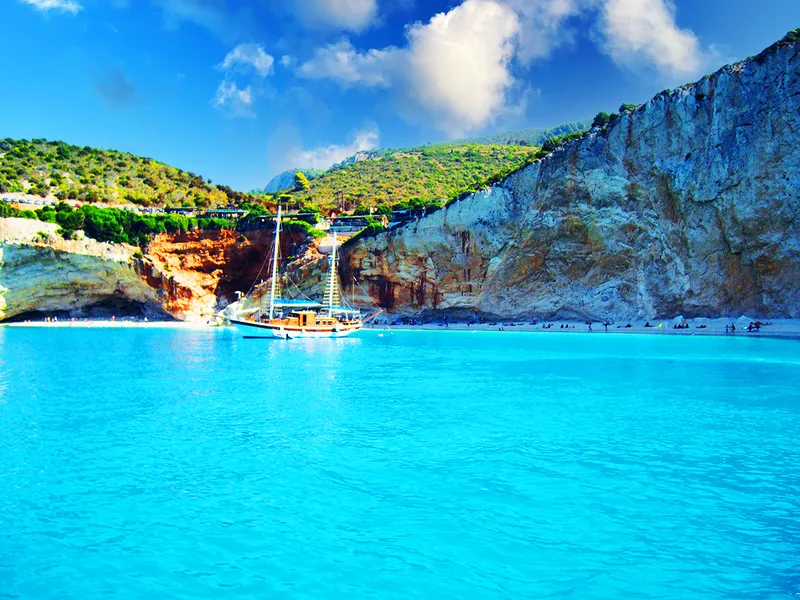
Porto Katsiki: the one from the photographs
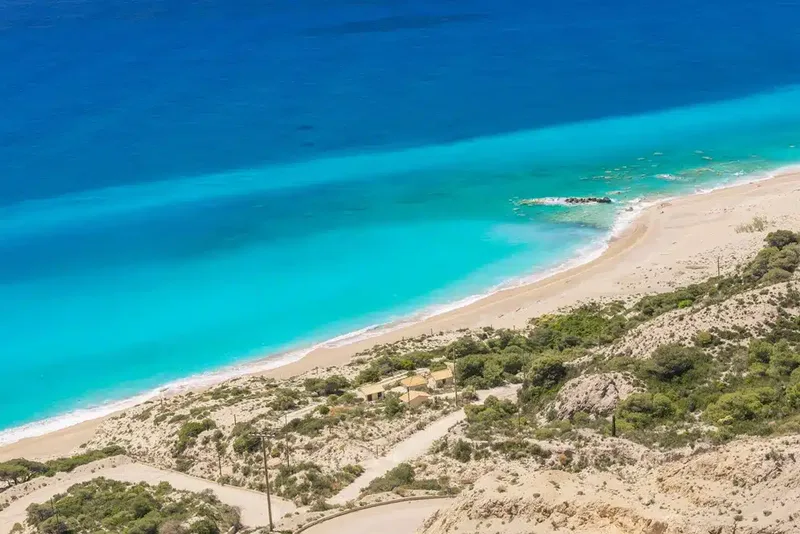
It sits at the southern end of the coast, past the village of Athani, at the bottom of a road that drops through olive groves and narrows as you get closer. The car park is up on the plateau, with a small canteen beside it, and that is where the picture you know comes from: the wall cut straight down and the tongue of pebbles below.
Plenty of people stop there, take the shot and drive on. I do not blame them.
To get down you take a staircase glued to the rock. Going down takes a few minutes, coming up is felt, especially around one in the afternoon when the stone is hot. Below, the water deepens sharply a few metres out and it is the clearest I know on the island. There is no natural shade once the sun is high, and in August the umbrellas go early, so bring water and something for your head.
One thing gets muddled often: in 2015 it was the path here that was damaged, not the beach. What happened at Egremni is a different, worse story.
See Porto Katsiki →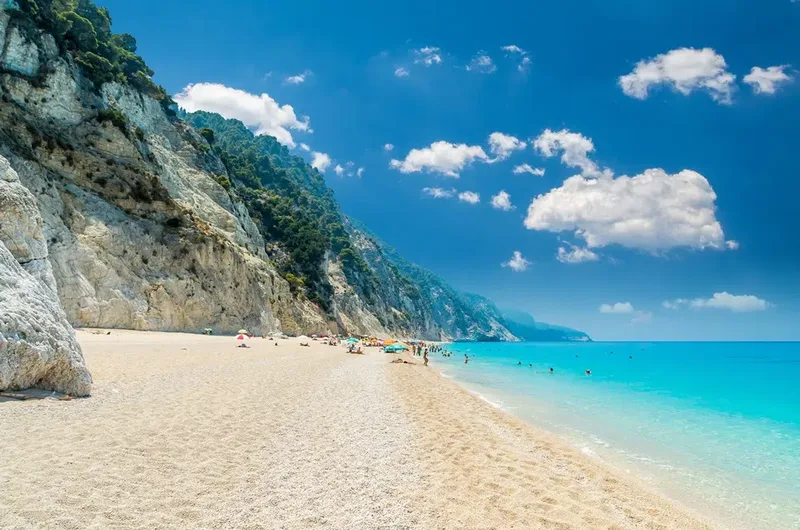
Egremni: here I have to be honest with you
Egremni lies a few kilometres north of Porto Katsiki, on the same road out of Athani. It is a long ribbon of white pebbles under a high wall, with water running through every shade of blue, and it is the most beautiful beach I have seen in my life. That was the pleasant part.
Land access broke in the 2015 earthquake, was rebuilt some years later, then broke again. Last winter a rockfall hit the staircase and the lower railings once more. The rubble was cleared, but by people who wanted to get down, not by the authorities, and no engineer carried out a safety inspection. Officially the beach is closed to foot and vehicle access. The car park at the end of the road no longer exists, and cars now stop more than a kilometre higher up.
You will still see people going down, and you will find fresh photographs online. I do not recommend it. I am also not giving you a step count, because the sources do not agree on one.
The option that works year after year is the boat from Vasiliki harbour, around fifty minutes on the water. The rock face looks better from the sea anyway, and on the way back there is nothing to climb.
Kathisma: the one you reach without a single step
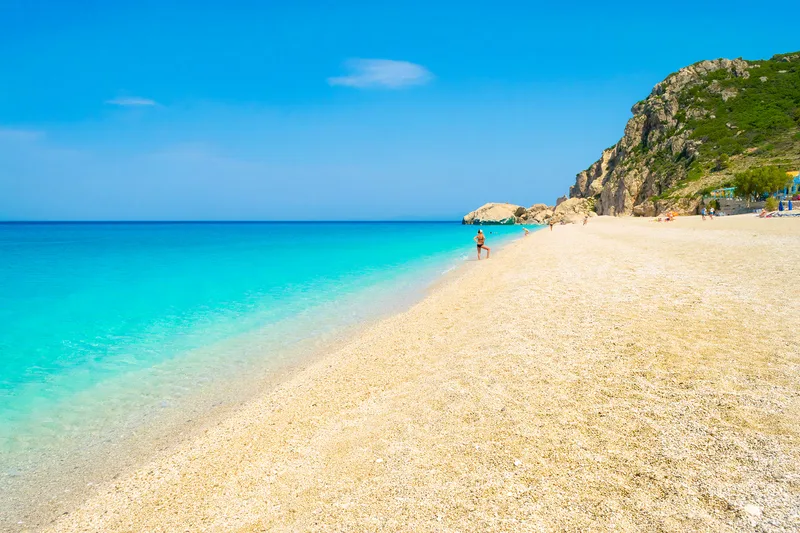
Kathisma is the beach I recommend for a first day, for days with grandparents, and for anyone with knees to look after. The road drops you straight at the sand. Nothing to climb down. You get sunbeds, showers, a few beach bars and tavernas on the hill above with terraces over the whole bay.
It is long, so you can choose between the organised stretch and the emptier ends. The sand is coarse, the water deepens fairly quickly, and waves roll in during the afternoon.
If you are lying there and see coloured canopies drifting in from the mountain, those are the paragliders. They take off around the village of Exanthia, from six hundred up to eight hundred metres, and every flight lands here on Kathisma. Their season runs from June to the end of September and depends on a westerly wind. Children watch them for an hour and forget the sea entirely.
See Kathisma →The wind here is called maistros, not meltemi
You will read in plenty of places that meltemi blows in Lefkada. It does not. Meltemi belongs to the Aegean and the Cyclades, and any text that brings it up here was copied from there by someone who never came to the island.
The Ionian summer wind is called maistros. It comes from the north west, starts around midday, builds through the afternoon and dies at sunset. It blows steadily from May to September and it is gentle compared with what happens in the Aegean.
For you on a beach, that means something very practical. Mornings usually bring a flat sea and the colours come out. Afternoons churn the water and the blue fades. It is not a law, it is a pattern you see almost every day.
In Vasiliki bay, a story of its own, the afternoon wind even has a name. Windsurfers call it Eric. It swings round about one o'clock and climbs to four or six on the Beaufort scale, while in the morning that same bay is glass, perfect for learning.
When the car park is full, what then
Do not insist. I have watched people lose an hour and a half circling the Porto Katsiki plateau, in August, at noon.
Out of the village of Kalamitsi runs a narrow road with tight bends, some four and a half kilometres long, serving a whole string of coves: Kavalikefta, Avali, Megali Petra, Gaidaros. Kavalikefta has sunbeds, umbrellas and a small cafe, so that is the version with facilities. Megali Petra is the one with big boulders in the water and on the shore, probably debris from old landslides, and very good for snorkelling. The water there drops away suddenly, and the southern end is used by naturists. Parking is tight everywhere along that road, so come early.
Further south, also past Athani, lies Gialos. It has two canteens and a beach bar, parking behind them and steps straight down to the sand. In places you walk into the sea over big flat slabs, where water shoes help a great deal.
Gialos is large. That is its main argument in August: it swallows a crowd and you still find a corner of your own.
Mylos, the beach you have to walk to
Below the village of Agios Nikitas there is a beach no car can reach. It is called Mylos, meaning mill, after the old windmill on the headland above it.
The path leaves from the top end of the village, climbs briefly past the mill, then drops down the slope. A kilometre and a half each way, with about a hundred metres of height gain. Going down is easy. The hard part is the return, in full heat, and that is exactly where people give up.
The alternative is the water taxi from the village, which crosses in under five minutes. It has one flaw, explained to me by a local: from mid summer onwards a north westerly sets in during the afternoon and makes the return trip awkward. So go in the morning or the evening, and do not count blindly on a boat to bring you back.
One more thing, to save you staring at a map. The other two ways in are private and locked, and both ends of the beach are cliffs. There is no shortcut.
The mistakes I watch people make every August
First: flip-flops. The western beaches are pebble or coarse sand, the paths are stony, and the stairs come at the end of the day. Water shoes solve half the complaints I hear at six in the evening.
Second: setting off at noon. Car parks fill before midday, the light goes harsh, the wind gets up. Leave at nine and you get the beach, the parking space and the colours. Leave at twelve and you get a queue.
Third: the wrong expectation about the water. This is not a sheltered bay. It deepens abruptly along most of this coast, and at Porto Katsiki and Megali Petra very abruptly indeed. With a small child who cannot swim, the east coast is the right answer, not this one.
And the last one, less a mistake than an expectation. The west coast is not a place with services. No natural shade, no pharmacy or cash machine round every corner, patchy phone signal in places, and out of season half the canteens are shut. Come prepared, with water and food in a rucksack, and the beach repays you tenfold.
If you have a single day and want no risk, go to Kathisma in the morning. If you have a week, do them one by one and accept that one of them will go badly. It happens to locals too.
Frequently asked questions
Which is the most beautiful beach in Lefkada?
Porto Katsiki is the most spectacular seen from above at the car park. Egremni is lovelier up close, but land access to it is officially closed. If you want turquoise water without a single step, Kathisma is the safe answer.
Can you still walk down to Egremni?
Officially, no. The staircase rebuilt after the earthquake was hit by another rockfall, the rubble was cleared privately without any safety inspection, and the beach remains closed to land access. The reliable option is the boat from Vasiliki.
How hard is the climb back from Porto Katsiki?
It is a staircase fixed to the rock face, a few minutes going down and rather more coming up, especially in the heat. With grandparents, a pushchair or sore knees it is a poor idea. On those days choose Kathisma.
Why are there waves on the west coast in the afternoon?
Because it faces the open sea, and in summer the maistros blows, a north westerly that starts around midday and dies at sunset. Mornings are usually flat. Meltemi, mentioned in many texts, does not blow in the Ionian Sea at all.
Which beach should I choose with small children?
Kathisma in the morning, while the sea is calm, or the bays on the east coast, where the water stays shallow and still. Porto Katsiki and Megali Petra drop away sharply a few metres from the shore, so they suit swimmers only.
Planning your Lefkada holiday?
Tell Ema what you're looking for. She lives on the island and only recommends stays she has seen with her own eyes, so you get a personal answer, not an automated one.
Explore the staysMore from the journal
Lefkada in September: what actually changes, with numbers
A sea at twenty five degrees, four rainy days in the month, free parking at Porto Katsiki and people who have time to talk again. Plus the part nobody writes down: what closes, what does not flow, and who this month is not for.
What to eat in Lefkada, if you want the local food and not the tourist menu
A bourdeto with no tomato in it, a lentil grown at nine hundred metres and sold out in twenty days, an olive that turns white as it ripens and a red wine as dark as ink. Plus the list of things there is no point looking for here.
Lefkada with kids: gentle beaches, calm bays and Ema's tips
Where the water entry is gentle, where to find shade at noon and which activities genuinely work with little ones. The family guide, built from parents' questions.