What to eat in Lefkada, if you want the local food and not the tourist menu
A bourdeto with no tomato in it, a lentil grown at nine hundred metres and sold out in twenty days, an olive that turns white as it ripens and a red wine as dark as ink. Plus the list of things there is no point looking for here.
The second question my guests ask, right after the beaches, is what people eat here. The short answer disappoints them a little: food in Lefkada is not spectacular. It is good, which is a different thing altogether.
The island has no textbook cuisine with ten famous dishes known across Greece. It has a handful of recipes left behind by the Venetians, a mountain lentil that even the people who do not grow it boast about, an oil made from an olive that turns white as it ripens, and a red wine so dark it looks like ink. The rest is fish, garden vegetables and olive oil poured without anyone counting.
Below is what I order, what I buy to take home, and at the end, what there is no point looking for.
Bourdeto has no tomato in it
You will find it on plenty of menus, translated as something in tomato sauce. It is not. Real bourdeto is fish cooked slowly with onion, oil and paprika, sweet and hot together, and all that red on the plate comes from pepper, never from tomato. The first time this was explained to me, in a kitchen down by the harbour, I sat there with the spoon in mid-air.
The name comes from the Italian brodetto, meaning broth. It is a Venetian inheritance, like a lot of things here. To be entirely fair, it is Corfu's signature dish rather than Lefkada's, only it gets cooked all along this coast. The classic fish is scorpionfish, the ugly spiny one, though ray or octopus work too.
Order it with plenty of bread and cold water beside it. If you cannot take the heat, say so at the start. Some kitchens make a milder version, others give you a long look and make it their way anyway.
Savoro, sofigado and the rest of the Venetian inheritance
Savoro is fish fried and then left in vinegar with garlic and rosemary. The technique is called saor in Venice and it was invented so the catch would survive on board without ice. It is eaten cold, as a starter, and it is exactly right on an August evening.
Sofigado is the dish I look for up in the mountains. The rest of the Ionian islands make one version, here they make it with beef, a lot of garlic, quince and petimezi, grape must boiled down until it thickens. The result is sweet and sour, heavy, autumnal. You will not see it on a beach menu.
Then there is kokoto, rooster simmered long and served with thick spaghetti, the Sunday dish of the upper villages. And riganada, less a dish than a habit: slices of dry bread, olive oil, enough oregano to cover them, salt. It takes two minutes, it used to be what field workers ate, and it now has its own festival in Karya around the middle of July.
The lentil that sells out in twenty days
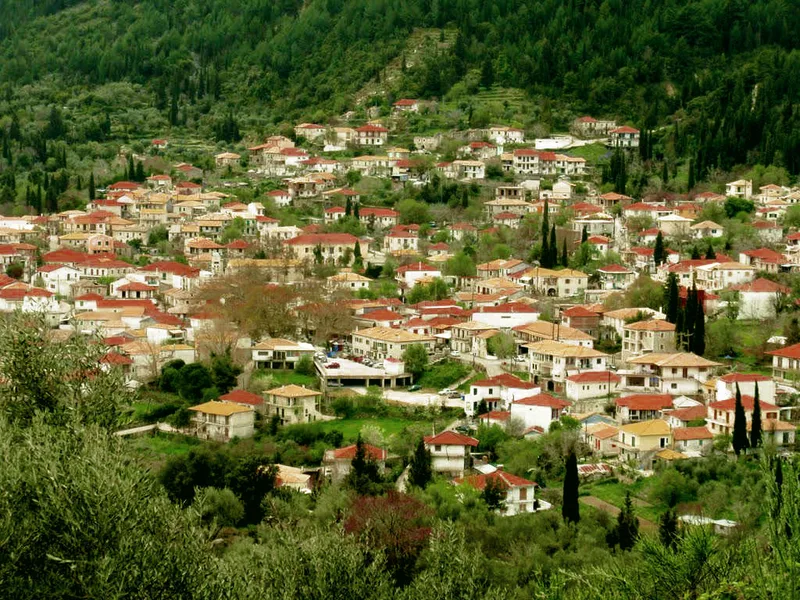
Englouvi is the highest inhabited village on the island, at around seven hundred and thirty metres. The lentils do not grow in the village but on the plateau above it, at some nine hundred metres, where nothing is irrigated, nothing is fertilised and the weeding is done by hand. That is why they cost what they cost, and why they run out fast.
Twenty to thirty tonnes are gathered a year. The whole crop sells in about twenty days.
The seed is smaller than supermarket lentils and it cooks quickly, turning creamy, almost like set cream. It is eaten plainly, with oil, vinegar and raw onion on the side. On the sixth of August, the feast of Saint Donatos, the village boils it in big cauldrons beside the church and hands it out to everyone, with salted sardines, olives, bread and homemade wine. It has run like that since the early eighties and never turned into a ticketed show, which strikes me as a small miracle.
A sample of the variety sits in a United Nations gene bank. That is the detail I enjoy most: a lentil from a plateau in Lefkada, catalogued alongside seeds collected from all over the world.
See the mountain village tour →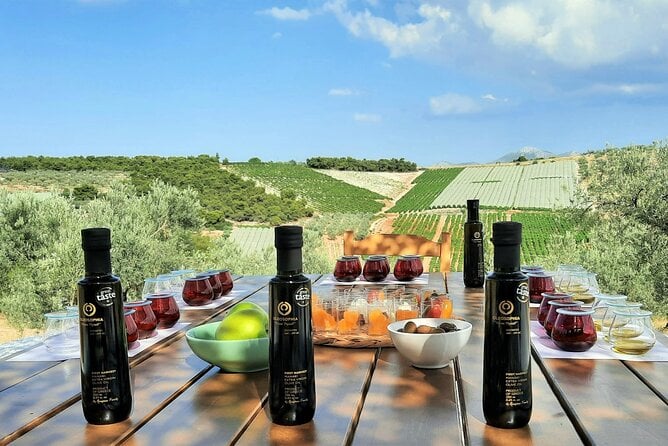
The oil: the olive here turns white when ripe
The local variety is called asprolia, from aspro, white, because the fruit turns white as it ripens. It is a small olive, under a gram, with a modest oil yield, grown on limited ground at low altitude. Alongside it people plant koroneiki, the variety grown across Greece.
The main harvest falls in November and December, so new oil does not exist in summer. What you taste now is last winter's crop. There is a second pressing in February, from fully ripe olives, giving a rounder, gentler oil with a deeper gold.
If the oil stings the back of your throat and makes you cough, it is good. That is not a fault, that is how young oil behaves.
If you want to take some home, buy it at a mill or in a village shop rather than off the souvenir shelf. In Sivros, a village a few kilometres from Vasiliki, an oil works built in the early 1800s ran until the seventies and is now a museum, with the stables, the storage room and the old wood-fired oven still in place.
See the oil and wine tasting →Vertzami, the wine that looks heavier than it is
Roughly ninety per cent of the island's vineyard is vertzami. It is an indigenous red with a colour close to black and one of the highest tannin levels in Europe, all of which makes you brace for a wine that flattens you. It does not. Alcohol and body are moderate, acidity is high, and the glass gives you bay leaf, cinnamon, blackberry, black cherry and a peppery note at the end.
The white is called vardea and comes from the south of the island, around Agios Petros, Sivros and Vasiliki. Gentle, unpretentious, good and cold at lunch.
The vines sit on terraces high up, between five hundred and eight hundred metres. The Venetians pushed viticulture here, first for raisins and only later for wine. A few nearly extinct varieties survive in the hands of two or three stubborn growers, under names you will not meet anywhere else.
In a taverna, ask for the house wine in a carafe. It is cheap and it is local. It is not always good, but it is honest, and by the third evening that matters.
The salami that came from the Venetian lagoon
Air-dried salami is the product the island genuinely boasts about, and rightly so. The know-how arrived from Burano, in the Venetian lagoon, with families that moved here at the end of the nineteenth century, and by the early 1900s it had become one of the first Greek foods sold under a name.
It is easy to recognise. Whole black peppercorns visible in the slice, garlic you can smell from two metres away, pork matured naturally in open air.
It is cut thin and eaten at the start of a meal with wine, ouzo or tsipouro, and it is one of the few things here that actually survives a suitcase. The producers are small family outfits, the oldest working since the forties. It carries no European quality seal, so do not let a label suggest otherwise.
How to order fish and how to pick a taverna
Fresh fish is sold by the kilo, not by the portion. Asking to see it is completely normal: the tray comes out, you pick your fish, it goes on the scales in front of you and only then to the grill. Ask straight out what the kilo costs and how much your fish weighs. Nobody minds, this is how it works everywhere in Greece.
Frozen fish has to be marked on the menu, usually with an asterisk. If you see ten kinds of fish at a fixed price per portion, none of them came off a boat this morning.
The best value is small fried fish, gavros or marides. They cost a fraction and taste better than a big expensive specimen.
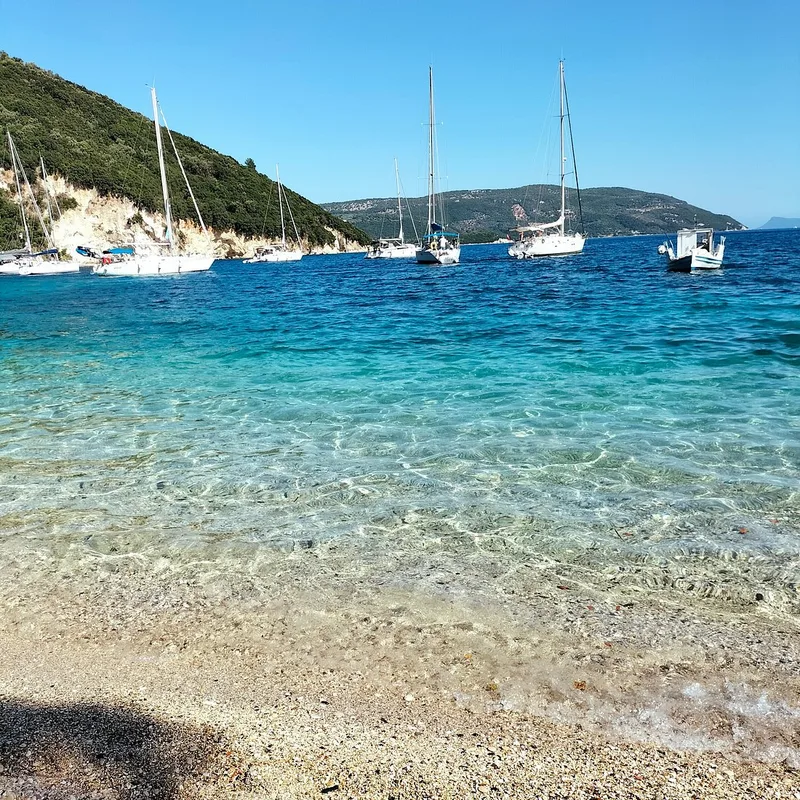
As for the taverna, I look at three things: a short menu, locals at the tables after nine in the evening, and nobody pulling me in off the street. Then I ask what was cooked today. The dish of the day, made in a pot that morning, is almost always the best thing in the kitchen, and in the bays on the east coast, with tables a few metres from the water, that is exactly what I order at lunch.
What you will not find here, however hard you look
Do not go looking for Lefkada cheese. It sounds odd, but there is no cheese dairy on the island at all, and the milk produced here travels to the mainland, to Epirus, to be processed. What you do find is homemade cheese kept in a barrel, in mountain tavernas, and it is very good. It simply has no brand name and it will not travel home with you. If someone sells you a named cheese as an island speciality, it most likely comes from Zakynthos or Kefalonia.
Do not go looking for salt either. The lagoon salt pans were a serious business for five centuries, with Venetian rules and plans drawn up by an engineer in 1725. The old basins stopped in 1948, the newer ones in 1990. Anything sold today as Lefkada salt is most likely Greek salt packed locally.
There is also the calendar problem, which nobody mentions. The lentils are gone within weeks of the harvest. New oil arrives only in November. Thyme honey from the south west is made in summer, in small quantities, and it goes fast at the Dragano festival.
Honestly: Lefkada is not a food destination. It is an island where you eat very well if you know where to sit down, which is not the same claim. If you are coming for the food and nothing else, Crete gives you more.
Frequently asked questions
What is the traditional food of Lefkada?
Bourdeto, fish cooked slowly with onion and hot paprika, and savoro, fried fish left in vinegar with garlic and rosemary. From the mountains come the Englouvi lentils, while sofigado, made with beef, quince and boiled grape must, is the local take on an Ionian stew.
Is bourdeto made with tomato?
No, the authentic version has no tomato at all. The red colour comes from sweet and hot paprika, and the base is onion, oil and fish. Many translated menus wrongly describe it as being in tomato sauce.
Why are Englouvi lentils so expensive?
They grow on a plateau at around nine hundred metres, with no irrigation, no fertiliser and weeding done by hand. Twenty to thirty tonnes are gathered a year and the whole crop sells in about twenty days, so demand always outruns the harvest.
Which local products are worth taking home?
Olive oil bought at a mill or a village shop, air-dried salami, Englouvi lentils if any are left, thyme honey, pastelli and mandolato. Branded local cheese and island salt are traps, since neither is produced here.
Is it easy to eat vegetarian in Lefkada?
Very easy. Greek cooking has a long list of fasting dishes inherited from the Orthodox calendar: beans, lentils, baked vegetables, wild greens pies, courgette, salads. Say you do not eat meat and half the menu heads your way.
Planning your Lefkada holiday?
Tell Ema what you're looking for. She lives on the island and only recommends stays she has seen with her own eyes, so you get a personal answer, not an automated one.
Explore the staysMore from the journal
Lefkada in September: what actually changes, with numbers
A sea at twenty five degrees, four rainy days in the month, free parking at Porto Katsiki and people who have time to talk again. Plus the part nobody writes down: what closes, what does not flow, and who this month is not for.
Porto Katsiki, Egremni or Kathisma: which one is worth it today
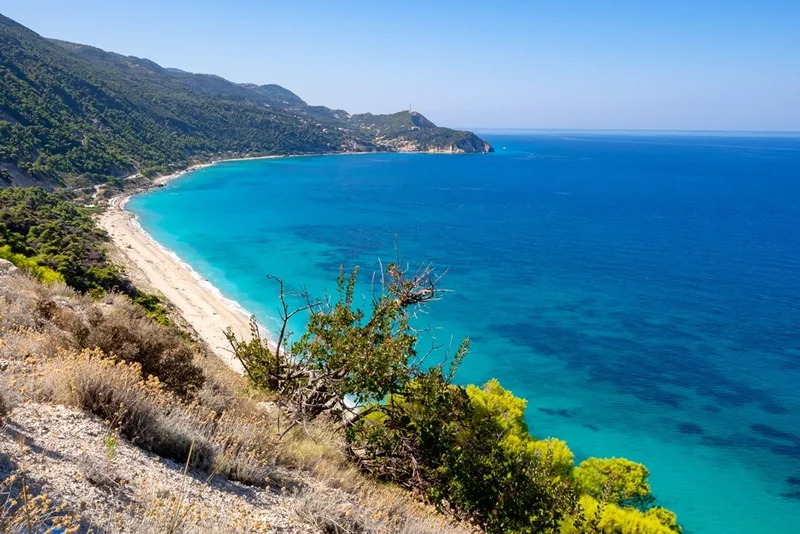
Three big beaches on one coast, three completely different days. One is officially closed, one you reach without climbing a single step, and the afternoon wind, which is not called meltemi, decides your day more than any morning plan.
Lefkada with kids: gentle beaches, calm bays and Ema's tips
Where the water entry is gentle, where to find shade at noon and which activities genuinely work with little ones. The family guide, built from parents' questions.