Lefkada in September: what actually changes, with numbers
A sea at twenty five degrees, four rainy days in the month, free parking at Porto Katsiki and people who have time to talk again. Plus the part nobody writes down: what closes, what does not flow, and who this month is not for.
If someone made me pick one month of the year, I would say September and I would not think twice. I live here all year round and I watch the island change its breathing: in August it draws air in, in September it lets it out slowly.
It is not a magical month, whatever the brochures say. It is a month when things settle: the car parks empty, the sea stays warm from the summer that has just ended, and the people here have time to talk to you again.
Here is what that means in practice, with numbers, with what closes and when, and with the part nobody guarantees you.
The numbers, with no poetry
Average air temperature in September is around twenty three degrees, against twenty six in August. Ten hours of sunshine a day, against twelve in July. Four rainy days a month and some fifty millimetres of rain, three times more than August, and two and a half times less than October.
The number that really matters is a different one. The sea sits at around twenty five degrees all month.
To put that in context, in October the sea here is close to twenty three degrees, warmer than it was in June. The island stays swimmable long after the crowds go home, and that is, to me, the worst kept secret in the Ionian.
Two warnings about these figures. They are averages, so one September can hand you three rainy days in a row and another none. And the air averages say nothing about the midday sun, which in the first half of the month still burns.
Why the sea stays warm
Water has inertia. It stored the heat of July and August and gives it back slowly, roughly a month behind the air. That is why June, for all its sunshine, has a colder sea than September, and why people who come early in the season are always surprised.
In practice: you walk in without thinking, stay as long as you like, and come out without that early summer shiver. Children can stay in the water for hours, which does not happen in June.
The air drops a little from August, so you can lie on the beach at midday without permanently hiding under an umbrella. Evenings, though, cool noticeably after sunset, above all on the west coast, where the air comes off the open sea, and out on a boat. Pack a light top and a pair of long trousers.
Every September I have guests who did not. I spot them by the way they hunch over dessert.
The beaches empty and the day rearranges itself
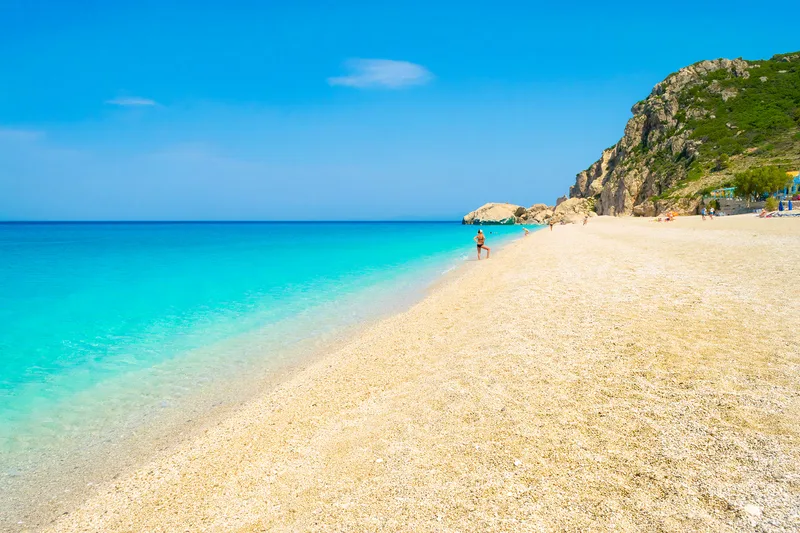
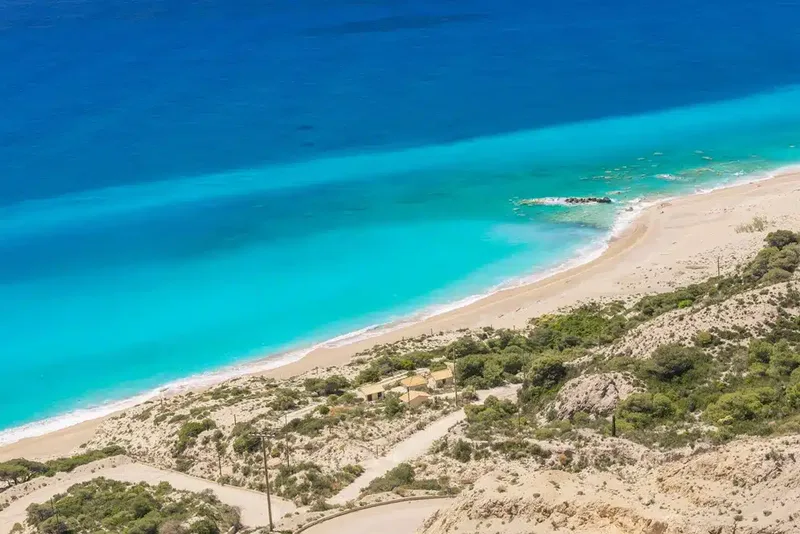
The difference between August and September shows up first in the car parks. At Porto Katsiki in August, if you arrive around eleven you turn back from the top without going down. In September you arrive at the same hour and find a space.
At Kathisma whole rows of sunbeds stay empty. At Kavalikefta you can be one of three families on the entire beach.
The order of the day changes too. You no longer have to leave at dawn to claim a spot; you can eat slowly and set off around ten. The wind rule still holds, since the maistros blows into September: mornings bring a flat sea and clean colours, afternoons churn the water. Towards the end of the month a few beach bars on the west coast start stacking the sunbeds for the season, so keep a big towel and an umbrella in the boot and do not rely on them.
Browse the beaches →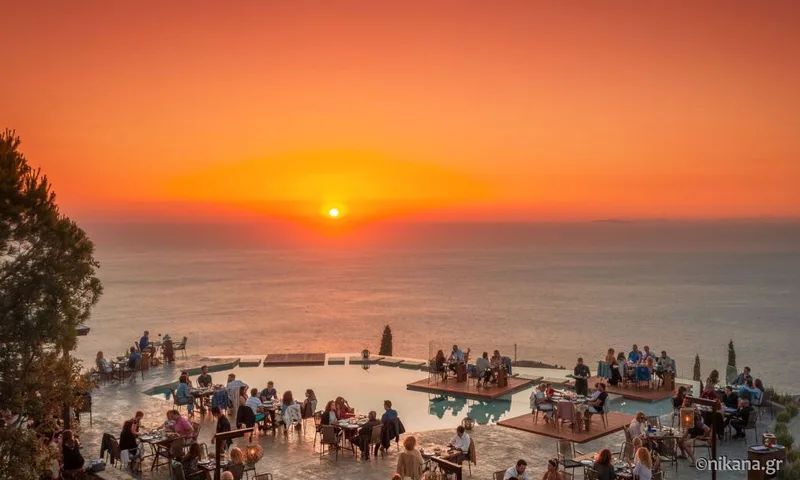
The light and the days on the water
The sun sits lower. The light turns warm earlier than in August and lasts longer, while sunset shifts week by week towards an hour when you can have dinner at a normal time and still catch the sky on fire. For photographs it is the best month of the year, no contest.
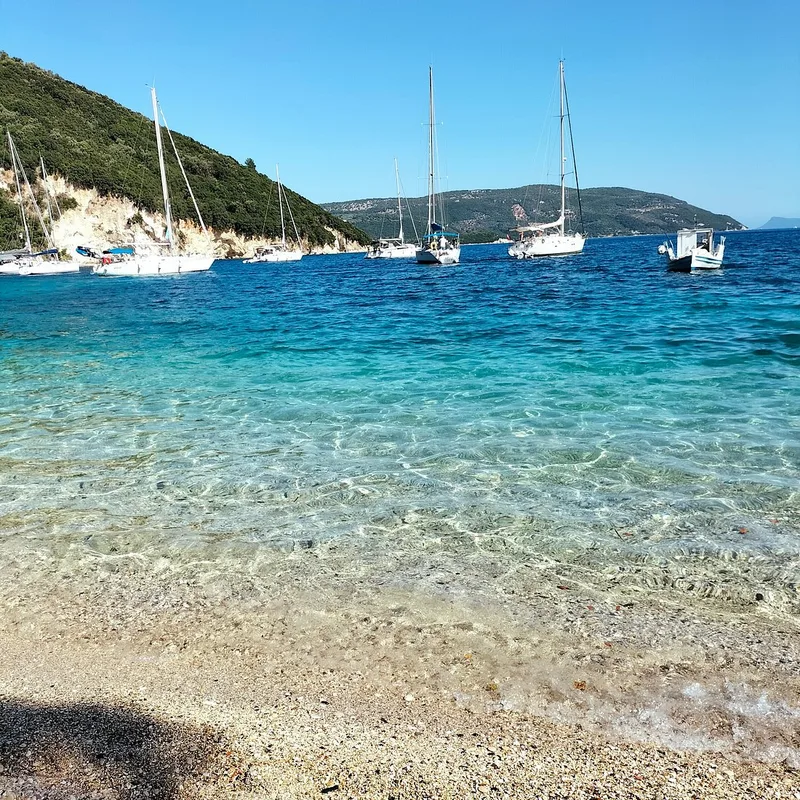
Boat trips run all through September with fewer people on board. Mornings often give a sea like oil, which matters enormously to anyone prone to seasickness.
If you pick a single outing on the water this month, make it the sunset one. And take a top with you: it cools faster out there than you expect, and by the time you come back it is nearly dark.
See the sunset cruise →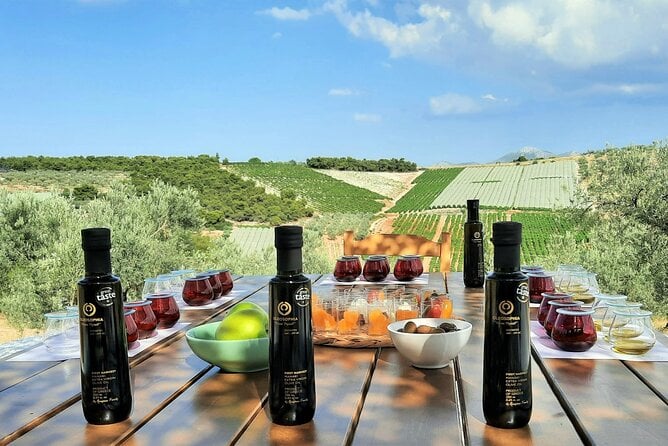
What the island does once it stops watching tourists
Here I will disappoint you slightly, so you do not arrive with the wrong expectations. September is not the olive harvest. The main picking happens in November and December, with a second pressing only in February. In September the olives are still on the branches, small and green, and the oil in the shops is from last winter. If someone sells you new oil now, ask which harvest it came from.
The Englouvi lentils are long gone. They are gathered in high summer, sold within about twenty days, and anyone driving up there in September finds an empty plateau.
What does happen is the grape. At the start of the month the village of Apolpena holds a wine festival, and the wineries on the terraces between five hundred and eight hundred metres are at their busiest. Early September also sees the end, in some years, of the international folklore festival in town, which runs Sunday to Sunday at the close of August and brings groups from dozens of countries.
These dates move from year to year, depending on sponsors and on how the weekdays fall. Do not take my word for them, check the municipality page when you plan.
What closes, and when
The island runs normally until about mid October. Tavernas, shops, pharmacies, car hire and excursion boats all operate through September without trouble. The town is open year round anyway, and so are the upper villages.
What thins out: the paragliding that lands on Kathisma ends its season towards the close of September, because it depends on a westerly wind. The water taxis to the southern beaches usually run through September and then stop for winter.
The floating bridge at the entrance to the island switches from its summer to its winter timetable around the middle of the month. It swings open several times a day, for ten or fifteen minutes at a time, to let boats through the channel, but the hours change from year to year, so do not memorise any schedule you found online.
And one more thing thins out without anyone writing it down: the nightlife. The bars in Nidri and in town stay open, but after the twentieth of September it is not the same crowd and not the same energy. If that is what you are after, come in August and take the rest of the package.
Prices, flights and how booking works now
Accommodation rates take a step down at the start of the month and another one towards the middle. It shows most on villas with pools and on places for large groups, exactly the ones booked in winter for August.
Last minute works too, within reason. The good properties still get taken, only the window is three or four weeks rather than six months.
If you have fixed dates and want one particular place, look early. If you are flexible, a month ahead is almost always enough.
And there is one more thing to work out, which people forget: flights to Preveza thin out in September, and towards the end some summer routes close until spring. Check the plane ticket first and the accommodation second, not the other way round. I have seen people with a villa booked and no way of reaching it.
What September does not guarantee
It does not guarantee perfect weather. Four rainy days a month means you might catch one, and when it rains here, it rains properly. This island gets over a thousand millimetres a year, more than much of Romania. That is why it is green, with pines running down to the beaches and plane trees in the upper villages, but nobody tells you that while selling you a holiday.
It does not guarantee the waterfalls either. Dimosari, above Nidri, barely flows at the end of summer. It picks up when the autumn rains arrive, so in September you can find yourself standing in front of a nearly dry bed after an hour of driving.
Egremni stays officially closed in September as well. Fewer people changes nothing about the state of the rock face above it.
And it does not guarantee silence. The first half of the month is still season: Greeks and Italians keep coming until around the twentieth, weekends fill up, and Kathisma on a Saturday still looks like August. The real emptiness arrives in the last week.
So who is it for, in the end? For couples, for people who swim a lot, for anyone driving the island alone who wants clear roads, for photographers. It is not for families with school-age children, for obvious reasons. And it is not for anyone chasing nightlife. Those guests I see in August anyway, and that is fine.
Frequently asked questions
Can you swim in Lefkada in September?
Yes, it is the best month for swimming. The sea has stored the summer heat and stays around twenty five degrees for almost the whole month. In October it is still close to twenty three, warmer than it was back in June.
Does it rain much in Lefkada in September?
On average there are four rainy days a month and some fifty millimetres of rain, far below October. Showers are usually short and heavy. The island gets over a thousand millimetres a year, so rain belongs here, even though summer barely sees any.
Is September cheaper than August?
Yes. Rates drop at the start of the month and again towards the middle. It shows most clearly on accommodation, where villas booked in winter for August suddenly become available, at figures never on the table in peak season.
What is open in September?
Almost everything: tavernas, shops, pharmacies, car hire, boat trips. The island runs normally until about mid October. Towards the end of the month a few west coast beach bars close and the paragliding season finishes.
What should I pack for September?
The same as for summer, plus a light top and a pair of long trousers for the evening. It cools noticeably after sunset, especially on the west coast and on a boat. Water shoes stay useful, since the western beaches are pebble.
Planning your Lefkada holiday?
Tell Ema what you're looking for. She lives on the island and only recommends stays she has seen with her own eyes, so you get a personal answer, not an automated one.
Explore the staysMore from the journal
Porto Katsiki, Egremni or Kathisma: which one is worth it today
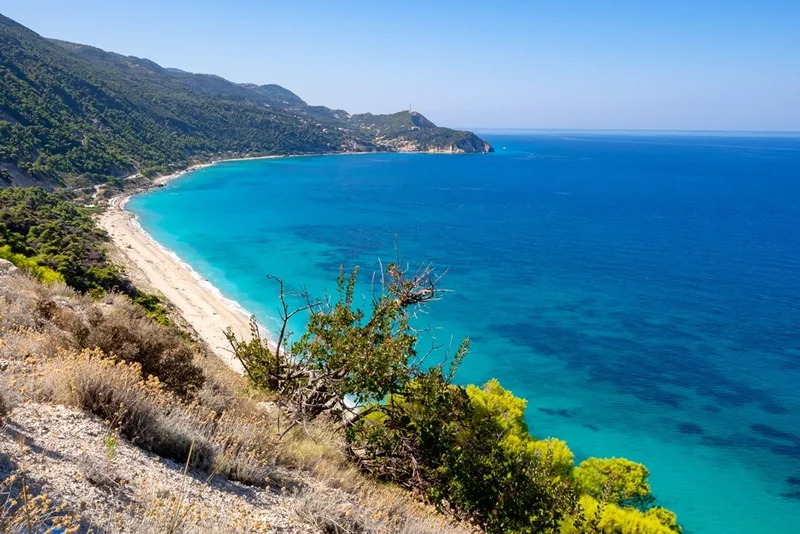
Three big beaches on one coast, three completely different days. One is officially closed, one you reach without climbing a single step, and the afternoon wind, which is not called meltemi, decides your day more than any morning plan.
What to eat in Lefkada, if you want the local food and not the tourist menu
A bourdeto with no tomato in it, a lentil grown at nine hundred metres and sold out in twenty days, an olive that turns white as it ripens and a red wine as dark as ink. Plus the list of things there is no point looking for here.
Lefkada with kids: gentle beaches, calm bays and Ema's tips
Where the water entry is gentle, where to find shade at noon and which activities genuinely work with little ones. The family guide, built from parents' questions.